Cary vs. Morrisville: Which Should You Choose?
A local Realtor's honest comparison of two of Wake County's most popular towns.
By Abdullah Al Loman, Realtor® · BluePearl Realty Group · August 2026 · 6 min read

Cary and Morrisville sit right next to each other in Wake County, share the same excellent public school system, and both show up on every “best places to live in North Carolina” list — but they’re genuinely different towns to actually live in. I get asked to compare them constantly, usually by relocating professionals trying to pick a home base before they’ve even seen either one in person. Here’s the honest, side-by-side breakdown.
The Short Version
Cary is the bigger, more established town — roughly six times the population of Morrisville, with a walkable downtown, mature neighborhoods, and a slightly longer commute to Research Triangle Park. Morrisville is smaller, newer, dramatically closer to RTP (often a 5-to-10-minute commute), more affordable, and one of the most internationally diverse towns in North Carolina. Neither is “better” — they suit different priorities.
By the Numbers
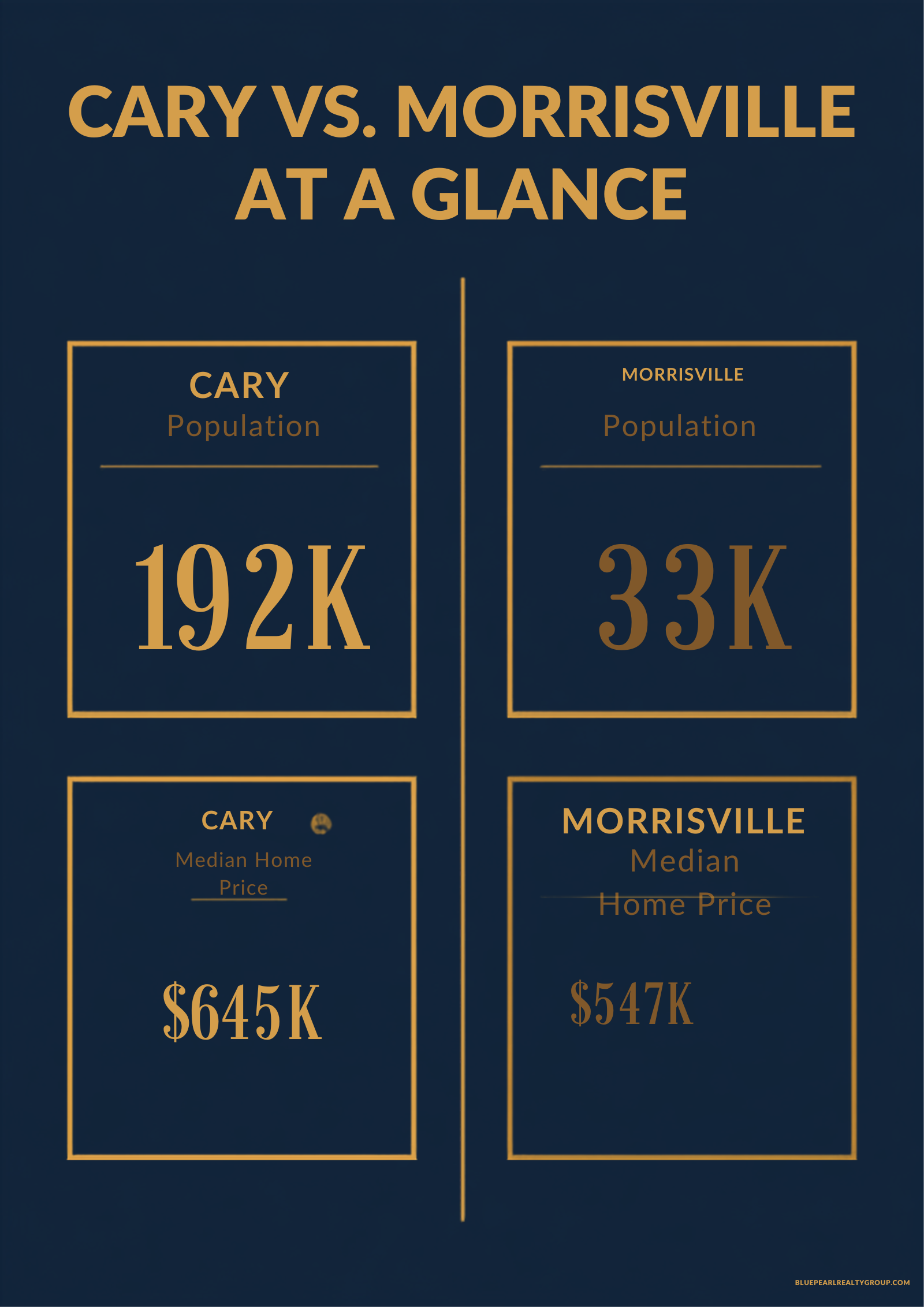
Cary’s population sits at roughly 192,000, making it one of the largest towns in North Carolina — genuinely closer in scale to a small city than a suburb. Morrisville, by contrast, has an estimated population of 32,628, with a median age of 35.
On price, the gap is real but not enormous: Cary’s median home price runs around $645,000, while Morrisville’s median sits closer to $547,000 — roughly a $100,000 difference for a smaller, newer town with a dramatically shorter RTP commute. Cary’s drive to RTP typically runs 15 to 25 minutes, while Morrisville residents working in RTP are frequently looking at just 5 to 10 minutes — RTP itself borders Morrisville directly, housing more than 385 companies and 55,000+ workers.
Sources: Movemetocarync, Zillow, Redfin — August 2026.
Schools: A Genuine Tie
This is worth settling upfront, because it’s the question I get asked most: both towns are served by the Wake County Public School System, and both have access to some of the highest-rated schools in the state. Cary is home to Green Hope High School (10/10 on GreatSchools) and Panther Creek High School — also a 10/10, with a 96% graduation rate and average SAT scores around 1350. Morrisville students are zoned into this same excellent Wake County system. If schools are your deciding factor, they largely cancel out — the real differentiators are elsewhere.
What Cary Actually Offers
Cary’s biggest advantage is that it’s finished — decades of development have produced a town with real infrastructure: a walkable downtown along Academy Street and Chatham Street, the new Downtown Cary Park, and long-established parks like Fred G. Bond Metro Park, Hemlock Bluffs Nature Preserve, and the Koka Booth Amphitheatre. For buyers who want an evening walk to a restaurant, an established neighborhood with mature trees, and a town that already has its identity figured out, Cary delivers that in a way a newer town simply can’t yet.
The tradeoff is price and commute — you’re paying a premium for that maturity, and depending on where you land in town, RTP is a real drive, not a quick hop.
What Morrisville Actually Offers
Morrisville’s pitch is almost the inverse: value and proximity. You’re paying roughly $100,000 less at the median for a home that’s frequently newer, and if you work anywhere in RTP, your daily commute might be shorter than most people’s grocery run. Morrisville is also genuinely distinctive culturally — locally nicknamed North Carolina’s “Little India,” with roughly 46% of residents identifying as Asian Indian, alongside a broader international population that’s made it one of the most diverse towns in the state. That shows up in daily life: a strong scene of South Asian restaurants and markets, and cultural festivals throughout the year.
What Morrisville doesn’t have, yet, is Cary’s decades of built-out downtown infrastructure — it’s a newer, still-maturing town, so if walkability and an established town center matter most to you, it’s a fair trade to weigh against the commute and price advantages.
How to Actually Choose
If you work in RTP and hate commuting, Morrisville is hard to argue with — a 5-to-10-minute commute is a real quality-of-life difference that compounds every single workday. If you work in downtown Raleigh, Durham, or somewhere that isn’t RTP itself, that commute advantage shrinks and Cary’s other strengths — walkability, established neighborhoods, more retail and dining variety — start to matter more. If budget is tight and you want the most home for your money while staying in this same excellent school district, Morrisville’s lower median price is worth a serious look. And if you specifically want a mature, walkable town with a real “downtown” feel and don’t mind paying for it, Cary is going to be hard to beat in this corridor.
Sources
- Movemetocarync: Cary NC Housing Market Trends
- Zillow: Cary, NC Home Values
- Redfin: Morrisville Housing Market
- RaleighRealty: Moving to Morrisville
- Karen Tehrani: Cary Neighborhoods with RTP Commutes
- Carolina’s Best Agents: Living in Morrisville Near RTP
- GreatSchools: Panther Creek High School
- Blue Orchid Realty: Living Near Downtown Cary
Figures reflect publicly available data as of August 2026 and vary somewhat by source and reporting period.
Not Sure Which Fits Your Situation?
Let’s talk through your commute, budget, and priorities and find the right town for you.