Veridea: What Apex's $7 Billion Mega-Development Means for the Housing Market
A local Realtor's deep dive into the numbers, the timeline, and where the demand is really going to come from.
By Abdullah Al Loman, Realtor® · BluePearl Realty Group · August 2026 · 24 min read

The short version, if you only have two minutes: Veridea is a 1,100-acre, roughly $7 billion mixed-use development taking shape in south Apex, anchored by North Carolina’s first freestanding children’s hospital and a new Wake Tech campus. At full buildout it will add about 8,000 homes and tens of thousands of jobs to a town that currently has around 34,000 housing units total. The first residents won’t move in until 2028, and the project won’t be finished until the mid-2030s. In the meantime, the promise of that many future jobs is already pulling buyer and investor attention toward south Apex — which means the market effects are starting well before the shovels are anywhere near done.
What Is Veridea, Exactly?
Veridea is a 1,100-acre master-planned, mixed-use community under development on the south side of Apex, at the intersection of US-1, NC-55, and the I-540 extension. It’s being built by RXR, a New York-based real estate investment firm that bought the site for $91 million and has described the project as a “superstar region” play — a bet that this specific corner of Wake County is about to become one of the most important growth nodes in the Triangle. (RXR)
At full buildout, the numbers are genuinely hard to overstate for a town Veridea’s size:
- Roughly 8,000 residential units across single-family homes, townhomes, and apartments
- 12 million square feet of office, life sciences, and industrial/logistics space
- 3.5 million square feet of retail, restaurant, and civic space
- North Carolina’s first freestanding children’s hospital — a 500-bed facility developed jointly by UNC Health and Duke Health
- A new Wake Technical Community College campus serving roughly 3,000 students
- A total investment north of $7 billion across the full multi-decade build-out (the Town of Apex’s own figure), with the first phase alone representing about $3 billion (Apex NC) (RXR)
For context on scale: Apex’s entire town currently has an estimated population of about 85,800 people. (World Population Review) Veridea alone, at full buildout, is planned to house something in the neighborhood of 20,000 additional residents on land that, a few years ago, was mostly woods and farmland. This isn’t an infill apartment complex or a single subdivision — it’s closer in ambition to building a second downtown from scratch.
The Long Road Here: Why This Took Fifteen Years
If you’ve lived in Apex for any length of time, you may remember hearing about “the Veridea site” long before anything visible happened on it. That’s not your imagination. The project traces back to 2009, when the land was first identified for large-scale mixed-use development under a different ownership group. The town approved the underlying Sustainable Development – Conditional Zoning (SD-CZ) district in May 2011 — meaning Apex gave this project a green light more than a decade before construction actually started. (Apex NC staff report)
What followed was a long stretch of stalled ownership, legal wrangling, and administrative delay. The original developer group struggled to finance and execute a project of this size, and by December 2021, the entity holding the rezoning — Reader Communities — pulled its own rezoning request, effectively putting the project back to square one. (ABC11)
RXR’s entry changed the trajectory. The firm purchased the land, cleared the legal and financial logjams, and broke ground on infrastructure work in late 2024. The first vertical construction — the Summit House apartment complex — had its groundbreaking on October 28, 2025. (Multi-Housing News)
Why does this history matter for a market analysis? Because it’s the single biggest risk factor an expert reading this project has to flag honestly: this is the second attempt at building Veridea, the first attempt failed after a decade of trying, and even RXR — a well-capitalized, experienced developer — is now projecting a build-out timeline that stretches into the mid-2030s. Projects of this scale are exposed to interest rate cycles, construction cost inflation, tariff-driven material cost swings, and shifts in capital markets appetite for large mixed-use bets. “Eventually” and “by 2033” are doing a lot of work in any conversation about this project, and anyone making buying or selling decisions today based on assumptions about 2032 should build in real schedule risk.
What’s Actually Being Built, and When
Here’s the phase-by-phase reality, as best it can currently be pinned down:
Phase 1 — Veridea East (underway now through roughly 2027–2028)
- 1,100 single-family homes and townhomes, built by Lennar
- Summit House: a 291-unit luxury apartment complex (two buildings), broke ground October 2025, targeted to open to renters in early 2028
- Roughly 200,000 square feet of retail, restaurant, and commercial space
- The Wake Tech campus — a 340,000-square-foot facility on 34 acres, serving about 3,000 students
- Veridea Crossing, a roughly $100 million, 220,000-square-foot retail and office district, with site work already underway (Redfin)
Mid-term (roughly 2027–2033)
NC Children’s: a 230-acre campus at US-1 and NC-540, developed jointly by UNC Health and Duke Health. Groundbreaking is hoped for 2027, with the hospital opening targeted for 2033. At full operation, it’s projected to bring approximately 8,000 jobs to Apex and Wake County — a 500-bed hospital, an outpatient care center, 103 children’s and adolescent behavioral health beds, and a research and education enterprise tied to both UNC’s and Duke’s medical schools. (Duke Health) (Axios)
Long-term (into the mid-2030s)
The remaining balance of the roughly 8,000 total residential units, plus the bulk of the 12 million square feet of office, life sciences, and industrial/logistics space, and the bulk of the 3.5 million square feet of retail and civic uses.
If you’re a buyer or seller trying to time a decision around this project, the practical takeaway is: the first residents (Summit House renters) arrive in early 2028; the first Lennar homeowners arrive around the same time; the anchor economic engine (the children’s hospital) doesn’t open until 2033; and the project as a whole isn’t “finished” until sometime in the mid-2030s. That’s not a two-year story. It’s a ten-to-fifteen-year story, and different parts of the housing market will feel it at very different times.
The Infrastructure Piece Nobody Should Skip: I-540
Veridea’s location only works as designed because of a separate, enormous piece of public infrastructure: the Complete 540 project, NCDOT’s $2.5 billion Southeast Extension of the Triangle Expressway, which finally closes the outer loop around Raleigh. Phase 1 of that extension opened in September 2024, connecting the Apex/Veridea corridor to RDU Airport and Research Triangle Park in roughly 20 to 25 minutes. (Jim Allen Group) Phase 2 is under construction now, with 2026 expected to be a peak construction year and a full ribbon-cutting targeted for 2028. (Raleigh Home Finder)
This matters more than it might initially seem. Before this road existed, south Apex was a genuine commuting sacrifice for anyone working in RTP, north Raleigh, or Durham — the kind of drive that quietly took certain neighborhoods off a lot of buyers’ shortlists. As 540 closes the loop, it’s structurally redrawing which parts of Wake County count as “commutable” to the region’s largest job centers. Veridea isn’t just betting on its own jobs to create housing demand; it’s betting that finished infrastructure makes its location viable for people who work somewhere else entirely.
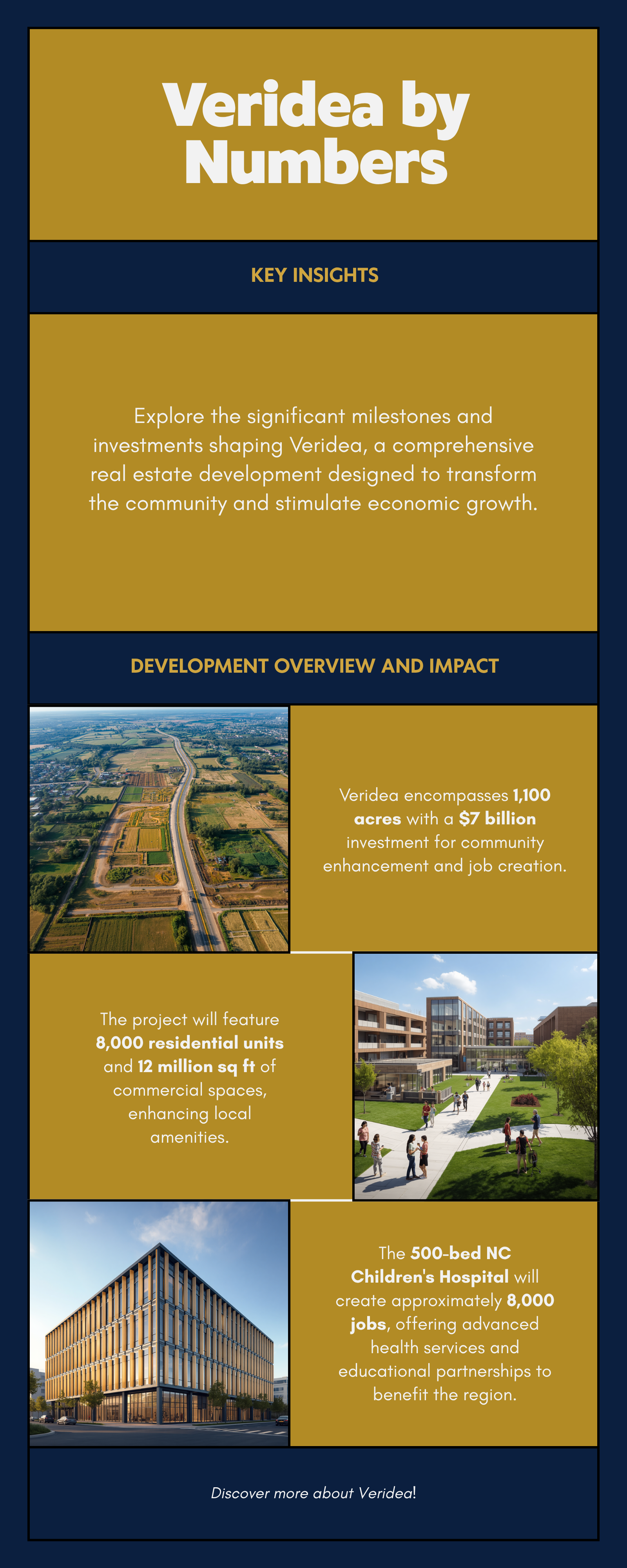
Veridea by the Numbers
1,100 acres. $7 billion at full buildout. 8,000 planned homes. 12 million square feet of office, life sciences, and industrial space. A 500-bed children’s hospital projected to bring roughly 8,000 jobs on its own. A new Wake Tech campus for 3,000 students. Numbers this size are easy to skim past — but they’re the reason builders, brokers, and investors across the Triangle are already watching this specific corner of Apex closely, years before most of it actually opens.
Sources: Town of Apex, RXR, Duke Health — August 2026.
Where the Housing Demand Is Actually Going to Come From
This is the question that matters most, and it’s worth being specific rather than hand-wavy about it. I see four distinct demand streams, on four different timelines, and they don’t all arrive at once.
1. Direct project jobs (concentrated 2027 onward). The single biggest number is NC Children’s own projected employment: approximately 8,000 jobs once fully operational. That’s not a rounding error for a town Apex’s size — Duke, UNC, nursing staff, administrative and support roles, research staff. Layer on Wake Tech’s roughly 3,000-student campus, plus whatever tenants eventually fill the 12 million square feet of planned office, life sciences, and logistics space. That commercial space is the least certain line item in the entire project — it will fill in based on demand RXR still has to go find — but it’s also the largest, by far, of any use in the plan.
2. Construction-phase employment (happening right now through the mid-2030s). A project delivering $3–7 billion of vertical construction over a decade needs a sustained construction workforce — tradespeople, project managers, suppliers — many of whom will be renting or buying somewhere in the greater Apex/Holly Springs/Sanford corridor for years at a stretch. This demand is real, it’s happening today, and it’s easy to overlook because it doesn’t show up in press releases the way “8,000 hospital jobs” does.
3. Infrastructure-unlocked in-migration (accelerating as 540 phases complete through 2028). As discussed above, the finished outer loop makes south Apex commutable to RTP and north Raleigh in a way it simply wasn’t five years ago. Some meaningful share of Veridea’s eventual residents will have nothing to do with Veridea’s own jobs — they’ll be RTP tech workers, Duke/UNC Durham-campus employees, or downtown Raleigh professionals choosing this corridor purely because the drive finally works and the housing is new.
4. The renter-to-buyer and healthcare-relocation pipeline (building through the early 2030s). Summit House’s 291 apartments are the first real “trial balloon” for Veridea housing demand — young professionals, traveling nurses, Wake Tech staff, and people wanting to live inside the development before they commit to buying will move there first. As the hospital approaches its 2033 opening, expect a wave of medical relocations — physicians, specialists, senior administrators — who tend to be higher-income buyers actively shopping for new-construction single-family product, exactly what Lennar’s Veridea East product is built to capture.
None of these four streams individually explains “why home prices in Apex will do X.” Together, they explain why builders, buyers, and investors are already positioning around this corridor years before the hospital breaks ground.
What This Actually Means for Apex’s Housing Market, Broken Into Timeframes
Near term (2026–2028): pressure on existing inventory, not Veridea’s own product. This is the window I’d flag most closely if you already own in Apex or the surrounding submarket. Veridea’s own homes and apartments aren’t delivering yet in meaningful volume. But construction employment, early corporate relocations, and 540-driven in-migration are all happening now. That demand has to land somewhere, and in the near term, “somewhere” is the existing housing stock in Apex, Holly Springs, and Cary — exactly the kind of established neighborhoods I covered in my Apex neighborhoods guide. Apex’s median home price was already up 6.5% year-over-year as of recent data, sitting around $610,000. (Triangle market data)
Medium term (2028–2032): new supply starts to matter, but it skews upscale. Once Summit House and the first Lennar phases are online, Apex finally gets meaningful new supply to absorb some of that pent-up demand. But it’s worth being honest about what kind of supply this is: a luxury apartment complex and a Lennar single-family/townhome product are not, generally, entry-level inventory. Large master-planned communities almost always lead with their highest-margin, most amenity-rich product first. First-time buyers hoping Veridea solves Apex’s affordability problem in this window are likely to be disappointed.
Long term (2032 and beyond): the real structural shift. This is when the thesis either pays off or doesn’t. If NC Children’s opens on anything close to its 2033 target and actually delivers close to 8,000 jobs, Apex genuinely stops being a bedroom suburb of Raleigh and becomes a self-sustaining employment center in its own right. That’s a highly plausible outcome. It is not a guaranteed one, given the project’s history, and it’s a decade-plus away from being provable either way.
Will Veridea Cool Prices or Heat Them Up? The Honest Answer Is: Both, at Different Times
This is where I want to push back gently on both the “Veridea will crash home prices with all that new supply” narrative and the “Veridea will send Apex prices to the moon” narrative, because I think the accurate picture is more interesting than either.
The case for moderation: 8,000 new homes is genuinely significant new supply for a town with roughly 34,000 total housing units today. (North Carolina Demographics) As that supply phases in through the 2030s, it should, at the margin, reduce the intensity of bidding-war conditions on existing Apex inventory simply by giving buyers more places to look.
The case for continued appreciation: New supply arriving in phases over ten-plus years, concentrated in higher price points early, arriving alongside thousands of new high-wage jobs and a structural infrastructure unlock (540) — that combination has historically been a net positive for prices in the surrounding submarket, not a negative one.
My actual read: expect existing-home appreciation in Apex to stay elevated through 2028, moderate somewhat (not reverse) as Veridea’s first phases deliver meaningful new inventory between 2028 and 2032, and then face a second, larger demand wave in the early-to-mid 2030s as the hospital and commercial space come online. The net effect over the full cycle is very likely still net-positive for property values in south and central Apex specifically, with timing mattering enormously for anyone trying to buy or sell opportunistically around it.
What Chatham Park and Other Master-Planned Communities Teach Us
Veridea isn’t the Triangle’s first attempt at a project this size. Chatham Park, just southwest in Pittsboro, is an even larger long-horizon project — roughly 7,000+ acres with a planned population that could eventually rival a mid-size city — that has been building out in phases for years, with early residential phases delivering well ahead of its full commercial and civic vision. The consistent pattern: initial announcements generate outsized attention relative to actual delivered units for years; early housing phases lease and sell well because they’re new and well-located; and the real employment and price impact doesn’t show up until the anchor institutions are actually operating, not just announced. If that pattern holds here, the next 24 months will feel more like “steady background interest” than “sudden market shock.”
Who Should Actually Be Paying Attention to This, and What to Do About It
If you already own in Apex, Holly Springs, or nearby Cary: the near-term (2026–2028) demand pressure from construction employment and 540-driven in-migration is a legitimate tailwind for your home’s value, independent of Veridea’s own delivery schedule. This isn’t a reason to panic-sell or panic-hold — it’s a reason to have a genuinely current valuation before making any big decision.
If you’re buying now and plan to hold 10+ years: south Apex, and the broader corridor along the new 540 extension, is a legitimate long-term appreciation thesis, but “legitimate long-term thesis” and “priced fairly today” are two different questions.
If you’re an investor evaluating rental product: Summit House is the market’s first real test of Veridea-adjacent rental demand, worth watching its lease-up pace in 2028 as a leading indicator.
If you’re waiting for Veridea to “fix” affordability in Apex: temper that expectation. The first waves of new supply here are explicitly upscale product. If affordable, entry-level inventory is your priority, Harnett County or parts of Chatham County may remain the more realistic near-term answer.
The Bottom Line
Veridea is real, it’s finally moving after fifteen years of false starts, and it is genuinely one of the most consequential projects to hit the Apex real estate market in a generation. But it is also a decade-plus story, not a two-year one, and the market effects are arriving in waves that don’t line up neatly with the press-release milestones. The demand pressure on existing Apex homes is already building today, well ahead of Veridea’s own product hitting the market in 2028. The bigger structural shift — Apex becoming a genuine employment hub rather than a bedroom suburb — is real, plausible, and still several years from being provable.
Sources
- RXR: Veridea $3B “Superstar Region” Announcement
- RXR: Groundbreaking Announcement
- Town of Apex: Official Veridea Page
- ABC11: Veridea Development History and Delays
- Duke Health: NC Children’s Campus Announcement
- Axios Raleigh: NC Children’s Hospital Details
- Multi-Housing News: Summit House Groundbreaking
- Redfin: Veridea Neighborhood Housing Data
- Jim Allen Group: Complete 540 Impact Analysis
- Raleigh Home Finder: Triangle Commute Times 2026
- World Population Review: Apex, NC Population Data
- North Carolina Demographics: Apex Housing Data
This analysis reflects publicly available information as of August 2026. Large-scale development timelines are subject to change; figures and dates represent developer and municipal projections, not guarantees.
Want to Talk Through What This Means for You?
Whether it’s your specific street, timeline, or investment goals — let’s put this analysis into context for your situation.